
Science as Storytelling with Sayantan Dutta
- Jun 16
- 3 min read
Young researchers are sometimes afraid to pursue something more “creative” like science communication. There is often a concern that science journalism or communication isn’t as serious as research. Sayantan Dutta considers science communication to be just as serious as laboratory work. A lot of top scientists contribute to science communication by writing books. They cite Cosmos by Carl Sagan as a popular example.
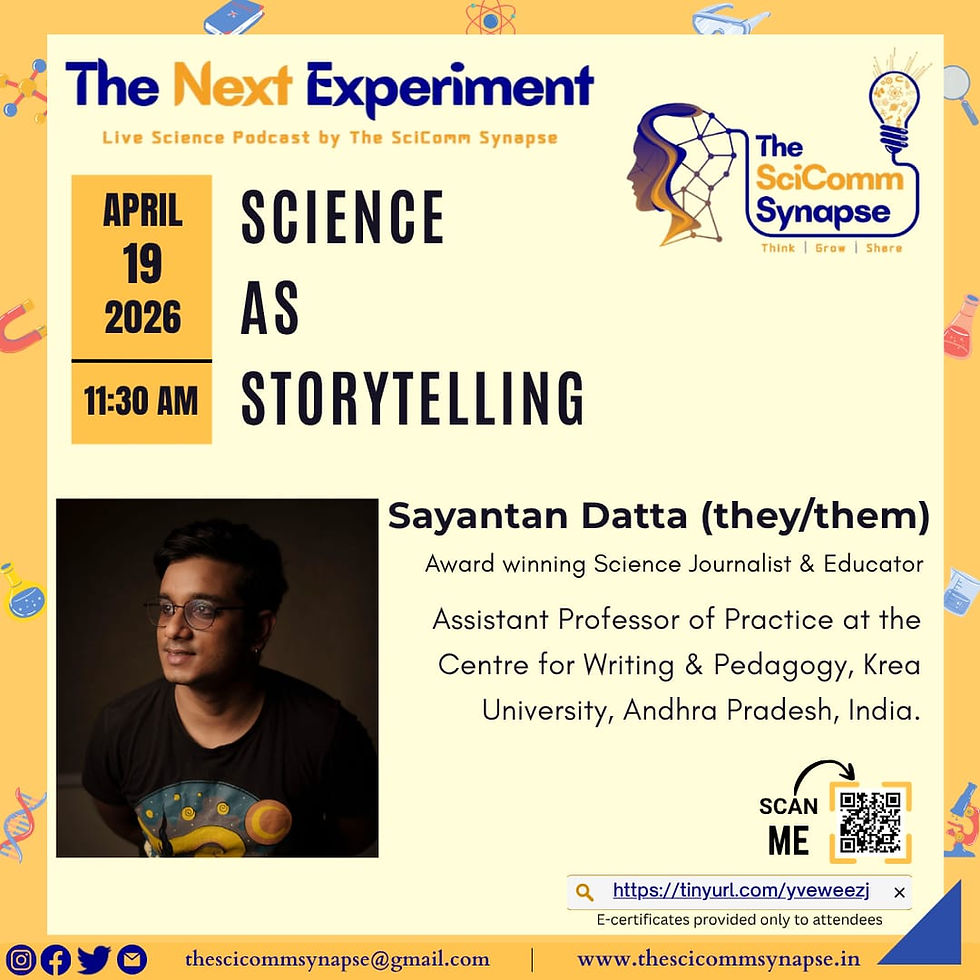
Ultimately, much of the laboratory research is funded by taxpayer money in India. Taxpayers are the largest stakeholders in science, and they must understand the fruits their investments have borne. It is imperative that they understand the work they’re funding. Science communication plays an invaluable role here. Thus, they argue that science communication is both creative and serious. Sayantan was kind enough to mentor our listeners on how to break into science communication.
They encourage those interested in science communication to start producing pieces on science in the medium of their choice. It can be blogs, articles, videos, podcasts, and they even know people who do science communication through dance. The idea is to get started, and the rest should fall in place eventually. It is important to start early so that one can begin to sharpen their skills. Another reason to start is that there isn’t necessarily a well-trodden path to enter science communication. One can only find that path once they start working and some part of their work clicks and finds an audience.
Another piece of advice Sayantan has for beginners is to start in a mentored environment. They encourage people to build collaborative networks. This can be achieved by talking to like-minded people, attending workshops, or by attending science festivals. Peer networks are invaluable for foraying into science communication. That is the only way to avoid feeling isolated in these non-conventional careers. A community also helps us to lobby collectively for opportunities. There are also certain skills people need to have to succeed in this field. Some skills are agnostic to the medium of communication.
This can be being able to explain technical topics to a layman. Science communicators also need to get comfortable with asking why a certain scientific discovery matters to a non-expert audience. We also need to figure out what mode of expression we’re comfortable with. Then we must hone our skills in that medium. Exploring identity is another important theme of Sayantan’s work.
They are interested in how those who do the science change the science being done. Sayantan encourages everyone to understand how certain parts of their identities affect their work. This also helps people understand the gaps that exist and how they can be filled. Sayantan quite rightly points out that science is an acquired skill. Thus, no one, no matter their background, is born a great scientist. They ask us to examine our unconscious bias towards people belonging to minority groups. We should also be mindful of our privileges, which have a large role to play in our success.
It behoves us to think about how we can use our privilege to open doors for those less fortunate than us. Minority groups often have to shoulder the burden of justifying their existence because of how underrepresented they are in science. This can be rather emotionally taxing. They encourage everyone with privilege to stand up for minorities to assure them that they’re not alone in this fight. They believe that the step forward for India lies in scientists being more politically aware and engaged. We were also joined by their cat towards the end of the session, which was a delightful addition to the podcast.
You can enjoy the rest of the conversation here - https://www.youtube.com/watch?v=xexIlolVuUM
Written by, Deven Matkari


Comments